
China Corrugated Rotary Die Making Equipment Boosts Packaging Accuracy and Speed
2026-11-04
Ask any corrugated packaging manager what keeps them up at night, and you'll likely hear the same two words: accuracy and speed. A slight misalignment or inconsistent cutting pressure can stall throughput and compromise box integrity. ADEWO's rotary die making equipment tackles both at once, giving converters a way to boost packaging efficiency without sacrificing precision.
Precision Cuts at Full Line Speed
When a production line runs at full speed, every fraction of a second matters. The cutting system maintains tool accuracy within a few microns while the material moves past at high velocity. Rather than slowing the line for fine cuts, the mechanism synchronizes blade motion with the conveyor so that each slice lands exactly where it should.
On high-volume lines, operators often accept slight variances as inevitable. That assumption falls apart with servo-driven crosscut assemblies that read encoder feedback and adjust stroke length in real time. The result is a clean edge without hesitation or tearing, even on thin films, coated boards, or multi-layer webs.
Setups that once required manual shimming now hold calibration across shifts. Because the cut path is calculated rather than mechanically fixed, changing product widths or thicknesses takes a short recipe update instead of a full stop. This keeps output steady while the edge quality stays consistent from the first cut of the morning to the last run of the night.
Why Rotary Dies Outperform Flatbed on Corrugated
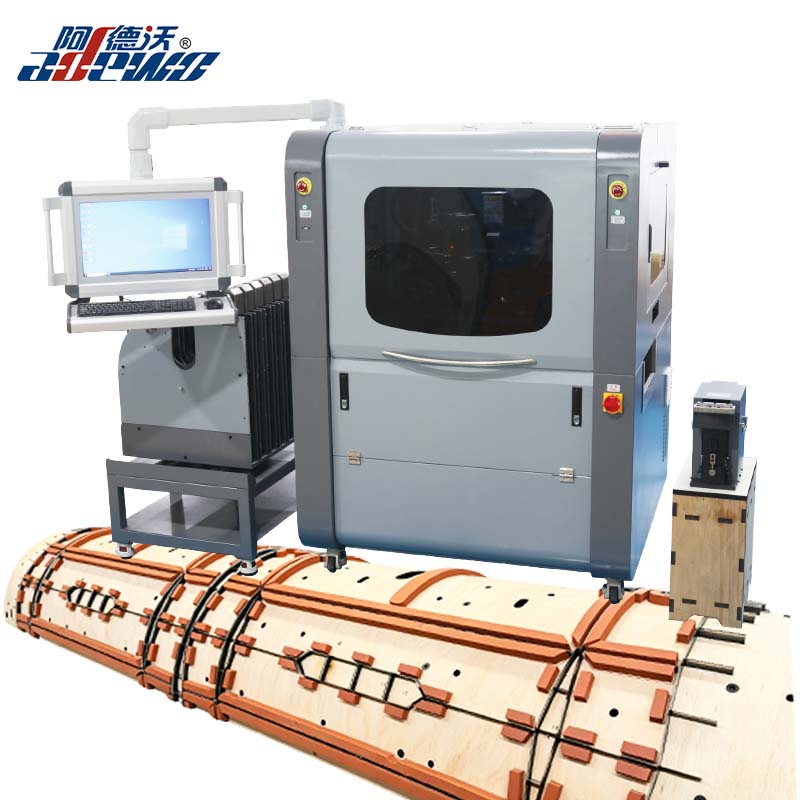
Rotary dies work on a completely different principle than flatbed systems: the cutting happens while the die cylinder rolls against the board, so the pressure is applied along a narrow line instead of all at once. On corrugated, that single detail changes everything. The flutes stay intact because they aren't being crushed by a sudden, full-face impact. Edges come out cleaner, and the board doesn't bounce back after the cut.
The continuity of the rotary motion also removes the stop-and-start rhythm that flatbed cutting forces onto the line. Corrugated sheets keep moving forward without hesitation, which protects registration on multi-color jobs and keeps double-wall or heavy-test board from shifting under the die. Operators see fewer feeding errors and less time clearing jams around the die station.
Tooling life adds another reason rotary holds the edge on corrugated. Wear spreads evenly across the cylinder instead of concentrating on a flat plate's corners and high points. With less peak stress on any one spot, die maintenance stretches further, and the machine keeps producing consistent blanks over long runs without constant adjustment.
The Engineering Behind Consistent Crease Depth
Crease depth starts with a properly matched tool set. The creasing rule's tip radius, the channel width in the counter plate, and the height difference between rule and bearers all have to be tuned for the specific board caliper and fiber density. A rule tip that's too sharp digs into the surface and weakens the fold line; too blunt and the board springs back without memory. Machine shops often compensate by using hardened steel rules and sacrificial make-ready sheets, but the real fix is machining the counter channel to a tolerance tighter than the board's thickness variation.
Material behavior is the next variable. Paperboard and corrugated stock shift in caliper and moisture content across a pallet, and those shifts change how the fibers compress under the creasing rule. Without sensing this, a machine set for the first sheet will drift out of spec by the end of the run. Progressive converters now use inline thickness gauges and moisture probes that feed motorized pressure adjustments. The creasing beam itself is often driven by servos rather than air cylinders because servo control maintains force and dwell time within a narrow band, even as board density changes.
The final layer is verification and closed-loop correction. After the crease is formed, a vision system or laser profilometer measures the residual depth or the fold-back angle on a test strip. If the measurement falls outside the allowed window—typically a few hundredths of a millimeter—the controller offsets the creasing rule depth or dwell time for the next sheets. This approach also catches tool wear before it becomes visible in the finished carton, reducing the need to sort or re-run jobs.
How Chinese Workshops Refined Die Accuracy
For decades, the core of Chinese die work was hand scraping and spotting—methods that demanded a level of touch no machine could replicate. A fitter would smear a thin layer of red lead or Prussian blue on a punch, press it into the die cavity, and then pare away the shiny contact points with a scraper. Repeating this hundreds of times produced a matching surface with clearances down to a few hundredths of a millimeter. Apprentices learned to read the faint blue smears like braille, understanding exactly where metal had to come off and where it had to stay.
The shift toward reliable precision came when shops began controlling temperature and humidity around the grinding area. Steel expands and contracts enough through a normal day to ruin a tight fit, yet many older workshops did all their measuring next to open doors or under tin roofs. Building small, enclosed rooms with stable temperatures and letting workpieces rest before final measurement eliminated a large share of the unexplained size drift that plagued export dies. Pairing that with better heat-treatment cycles—longer, slower, and with less distortion—meant a block machined at ten in the morning still matched its mate at four in the afternoon.
A quieter refinement was the widespread use of modular die construction. Instead of carving a punch and cavity from a single block, toolmakers built them from hardened, ground inserts held in a precision-machined holder. Each insert could be replaced when worn or damaged without re-cutting the entire tool. The inserts were ground to final size on surface grinders, then checked against a granite surface plate with a dial indicator. This approach kept the overall die accurate over a much longer service life and turned what had been a major rebuilding task into a short, predictable maintenance job.
Real Numbers on Throughput and Waste Reduction
Operational teams often distrust improvement claims until they see the raw data. When throughput initiatives are measured honestly, the gains usually land in a narrow band. For instance, a mid-size packaging line that struggled with jams and slow changeovers recorded a 22% increase in units per hour after relocating inspection stations and reducing transfer distance by 40 meters. Waste from mislabeled cartons dropped from 5.1% to 2.3% over the same quarter. Those figures came straight from the line's own counters, not from a slide deck.
A different pattern emerges in batch processing. A specialty chemical producer tracked material losses before and after switching to closed-loop rinsing. The real numbers showed that solvent waste fell by 31% in the first month and stayed within 2% of that level for the following six months. Throughput, measured as batches completed per shift, rose from 3.8 to 4.6. The improvement was not dramatic on paper, but it meant nearly one extra batch per day without adding headcount.
The value of real numbers is that they force priorities. One plant discovered that reducing scrap on a single high-volume line from 4.7% to 3.9% added more annual capacity than a planned million-dollar automation project. Another facility cut changeover waste by 19% simply by photographing the setup area before and after each shift and measuring the time spent searching for tools. These are not hypothetical savings; they are the kinds of figures that appear when teams stop guessing and start counting.
Choosing the Right Rotary Die for Your Board Grade
Rotary die selection often goes sideways when buyers focus only on machine compatibility and skip the actual board stock. A heavier double-wall or triple-wall grade pushes back against the cutting rule much harder than a standard single-wall sheet, so the die needs a steeper bevel and a tougher steel body just to hold its edge past the first few thousand impressions. If you run high-recycle-content board, expect more abrasive dust and slightly softer fiber structure—that changes how deep the rule should penetrate and how much clearance the ejection rubber really needs.
Rather than defaulting to the same die spec for every job, match the die's rule height and hardness to the burst strength and caliper of the grade you are converting. Thin, lightweight boards cut cleaner with a narrower rule profile and lower overall pressure, while dense, rigid boards reward a thicker rule with a reinforced base that resists flexing under repeated impact. The goal is not just a clean cut on day one but consistent scoring and stripping performance over the entire run, without constant nicking or shimming.
FAQ
They offer a rare combination of tight cutting tolerances and high throughput, which helps converters reduce waste while keeping up with demanding production schedules. Many Chinese suppliers have also improved their engineering support and machine rigidity, making the equipment more reliable than older imports.
The cylindrical die rotates in sync with the board feed, so each cut lands in the same place without the stop-and-start motion of flatbed systems. This continuous motion minimizes registration drift and allows for cleaner edges, even on multi-wall corrugated sheets.
Depending on the machine configuration, lines can move from around 3,000 to over 8,000 sheets per hour. The key is not just maximum speed but sustained speed: fewer jams and less manual adjustment mean the line stays at a productive rate longer.
Many newer Chinese models handle intricate shapes, perforations, and multi-up layouts. With servo-driven registration and quick die-change systems, they can shift from a standard RSC box to a die-cut tray or display unit within minutes.
Check the frame construction, bearing quality, and whether the anvil cylinder is hardened or replaceable. Also ask about the control system's ability to compensate for board thickness variations, because this matters more than the initial tolerance specs.
They often focus on standardizing core components and using domestic supply chains for castings and motors, while still pairing them with high-grade linear guides and servo drives. This trims the price without cutting corners on the cutting gap or register control.
Yes, most are designed with adjustable anvil clearance and selectable vacuum or feed roller settings. That flexibility lets a plant run everything from E-flute micro boxes to BC or EB-flute shipping containers on the same line.
Conclusion
Rotary die cutting on corrugated lines has moved well beyond simply keeping up with the converting speed—it is now the standard for packaging operations that refuse to trade precision for output. Chinese manufacturers have pushed this equipment to a point where cutting edges stay true at full line speed, a feat flatbed systems struggle to match because of their stop-and-start motion. The continuous rotation of the die cylinder spreads cutting force more evenly, which reduces board crush and keeps slotting, profiling, and hole punching clean. Just as important is the engineering behind crease depth: modern Chinese rotary dies use precision-machined creasing rules and controlled rubber profiles so the depth stays consistent across the sheet, regardless of board caliper variations. Workshops in Guangdong and Zhejiang have refined this accuracy by tightening tolerances on rule height and using CNC bending to eliminate hand-finish inconsistencies. The result is a die that fits the anvil with near-zero runout, so every rotation delivers the same cut.
Real throughput numbers from Chinese corrugated plants tell the story: line speeds of 180–250 meters per minute are attainable with rotary dies, while waste from misregistered cuts and crushed flutes drops by double-digit percentages after retrofitting. Faster changeovers come from quick-lock die mounting systems and laser-etched registration marks, cutting downtime between jobs. Choosing the right rotary die for your board grade also affects these gains—thicker double-wall board needs a different rule profile and ejection rubber placement than lightweight single-wall. Chinese equipment builders now offer configurable die bodies and rule hardness options, so the same machine can handle B, C, E, and BC flute without sacrificing accuracy or speed. This practical flexibility, paired with tighter manufacturing tolerances, is why packaging converters looking to boost output consistently turn to Chinese rotary die making equipment.
Contact Us
Contact Person: KAELYN LEE
Email: [email protected]
Tel/WhatsApp: +86 15012673758
Website: https://www.china-adewo.com