
Continuous Still Company Innovations Shaping the Future of Distilling
2026-11-13
Column stills used to be about volume. Now they are becoming precision instruments. As continuous still technology matures, a handful of companies are rewriting the rules, and DYE is one to watch. From tighter cuts to smarter heat recovery, these innovations are not just improving efficiency. They are changing what distillers can actually make. Here is a closer look at the shifts shaping the next generation of spirits.
Reworking Heat Recovery Around Real Production Schedules
Most heat recovery studies begin with a steady-state model, but real production schedules rarely behave that way. A dairy plant, for instance, may run pasteurizers flat-out for six hours, then stop for a two-hour cleaning cycle, and later switch to a lower-temperature product. Mapping those actual operating blocks shows when exhaust heat is genuinely available, and it often looks nothing like the daily average used in a feasibility study. Treating the production calendar as an input rather than a disturbance changes which heat sources are worth tapping.
That mapping can justify smaller buffer storage instead of an oversized heat exchanger. When a sterilizer releases hot condensate in sharp bursts, a modest stratified tank can hold that energy for the next preheat step, provided the schedule puts the two operations within a few hours of each other. In some cases, it is easier to shift certain thermal tasks—clean-in-place cycles, crate washing, or boiler feedwater preheating—into windows where recovered heat is abundant. This requires talking to production planners early, because moving a wash cycle by thirty minutes may unlock more savings than adding another heat exchanger.
For retrofits, the most effective approach is often to recover heat from streams that track the real load profile instead of chasing the hottest streams that appear only during rare full-capacity runs. Compact, fast-responding heat exchangers near the source can perform better than a large centralized network because they do not need long stabilization periods. A system designed around the schedule—not around a theoretical best case—tends to survive shift changes, product switches, and maintenance days without losing much performance.
Column Stills Sized for More Than the Biggest Distilleries
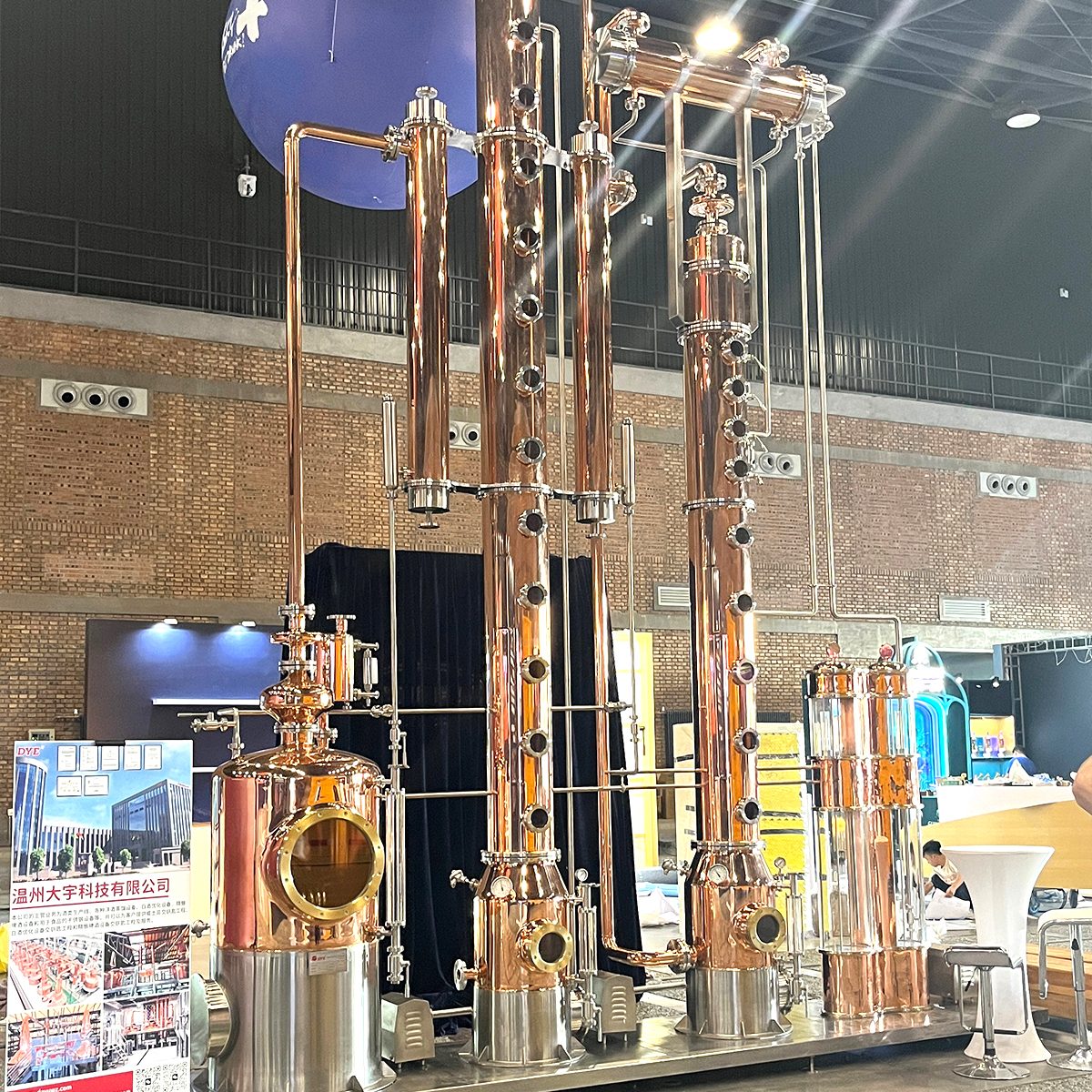
At certain industrial sites, a column still stops being a piece of equipment and starts behaving like a building. The largest beer columns rise more than a hundred feet, with diameters broad enough that workers enter through manways to inspect trays rather than reaching in from the outside. Compared with the copper pot stills used by even the largest single malt distilleries, these columns operate on a different order of magnitude: a single run can process mash at rates measured in thousands of gallons per minute, dwarfing what any whisky or rum producer would require in a week.
That scale is not an aesthetic choice. Fuel ethanol plants, industrial neutral spirit facilities and some large beverage operations use continuous distillation because they need to strip alcohol from enormous volumes of thin, fermenter broth without tying up an army of batch stills. The tall, wide columns make it possible to run around the clock, with feed entering near the top of one section and steam rising from below. Height provides the separation power; width provides the throughput. In practice, engineers push both dimensions until the limits become logistics, not chemistry.
Building and installing one of these giants is closer to constructing a pressure vessel than to coppersmithing a pot still. Sections are rolled and welded off-site, then hoisted into place in rings that get bolted or welded together under careful alignment. Internals such as sieve trays, downcomers and weirs are fitted after the shell is stable. Shipping clearances, foundation loads and wind shear all shape the final design, which means two columns with the same production target can end up looking quite different depending on where they stand.
Copper, Stainless, and What the Next Alloy Brings
Copper does not hide its age. It turns from penny-bright to a streaked brown, then settles into a green-black patina that records every spill, steam cloud, and thumbprint. Stainless takes the opposite route: it shrugs off acid, salt, and heat, but gives back almost no visual history. A stainless surface can look exactly the same after a decade, which is either comforting or a little cold depending on who is standing in front of it.
That split has shaped kitchens, bars, and workshops for decades. Copper gets chosen for warmth and a sense of craft; stainless gets chosen for endurance and easy cleanup. Neither fully answers the desire for a material that can age with character while still resisting real damage.
The next alloys are trying to close that gap without simply imitating either side. Some blends add a trace of tin or zinc to shift the patina, while others use new rolling and finishing methods to give stainless a softer, less mirror-like surface that picks up faint marks without corroding. The result is a middle ground where the material feels less static and less precious—more like something that can live in a room, collect a few stories, and still hold its shape.
Controls That Respond to the Mash, Not a Fixed Recipe
A fixed recipe assumes every potato behaves the same way, which anyone who has made mash knows is not true. The control system pays attention to how the material is breaking down and changes the blade speed, direction, and rest time without making you stop and dial things in.
Early in the process, the motor might use broader, slower pulses to crack dense pieces apart. As the mash softens, it tightens into shorter bursts so you get a light, airy texture instead of a gluey paste. The shift happens through resistance feedback rather than a timer counting down.
That feedback loop is what keeps the result consistent from batch to batch, even when the starting ingredients are not. You stay in charge of the finish, but the base decisions are made by what is actually in the bowl.
Moving From Pilot Runs to Full Output Without Rebuilding
A pilot run usually exposes the gap between what worked in simulation and what actually holds up under load. The goal is to carry that validated setup into full production without pouring time into dismantling fixtures, re-cutting brackets, or rewriting control logic. That only works when the pilot cell is treated as a trimmed-down version of the final line rather than a temporary prototype. Every sensor position, clamp stroke, and software limit needs to be chosen so it remains valid at higher cycle counts and longer shifts.
Once the pilot parameters stabilize—feed rates, dwell times, thermal offsets, and tolerance bands—the switch to full output becomes mostly a matter of loading demand instead of re-engineering the process. Some plants handle this by keeping the mechanical envelope unchanged and adjusting only scheduling, material buffers, and shift patterns. The equipment does not get rebuilt; it simply stops being underused. If a rebuild still feels necessary, the pilot run probably left too many open questions about repeatability and access.
What Happens When Spent Wash Becomes a Resource
When spent wash stops being treated as a disposal problem and starts getting handled like a raw material, the change is immediate. The dark, nutrient-heavy liquid left over from distillation no longer sits in massive evaporation ponds, leaching into soil or requiring constant tanker trips. Instead, it moves into closed-loop systems where its organic load becomes the point, not the penalty.
One of the quieter shifts is how much energy gets pulled back out. Through anaerobic digestion, the same chemical oxygen demand that makes spent wash dangerous becomes biogas. That gas can replace furnace oil in the distillery or feed generators on site. The leftover digestate still holds potassium, sulfur, and trace micronutrients, which makes it a practical soil amendment for nearby sugarcane fields rather than just a sludge to be buried.
There is also a quality angle that rarely gets mentioned. When treatment happens too slowly or incompletely, the resulting discharge can cause odor complaints and regulatory fines. But once the stream is redirected early, the plant avoids those bottlenecks. Operators get a steadier process, less freshwater makeup, and a byproduct stream that has an actual market value. Spent wash becomes less of a liability and more of a balance-sheet line that works in the background.
FAQ
A continuous still keeps feeding wash and drawing off spirit without stopping, so the process becomes a steady-state operation rather than a batch cycle. The newer designs focus heavily on column packing, precise temperature zones, and better reflux control, which gives distillers more influence over cuts and flavor than older industrial columns.
Heat recovery has become a central design goal. Instead of repeatedly heating and cooling a kettle, a continuous setup can reuse thermal energy across multiple stages, often through integrated exchangers and vacuum-assisted stripping. That lowers steam demand and makes a meaningful difference in both cost and carbon footprint.
In many cases, yes, but it depends on how the still is configured. By varying feed preheating, draw plates, and reflux ratios, distillers can retain heavier congeners that were once lost in early continuous columns. Some craft producers now use hybrid setups with a small pot-style rectification section to keep more texture.
Rather than replacing the distiller, automation has shifted attention to sensor-driven adjustments. Flow rates, vapor temperatures, and pressure differentials can be monitored continuously, allowing operators to make small corrections before a run drifts. The result is less guesswork and more repeatable spirit character across long production windows.
Stainless steel is still common, but copper contact in vapor paths and condensers is being placed more deliberately to support sulfur removal without compromising durability. Better passivation, laser-welded seams, and thicker column walls in high-wear zones also help equipment handle continuous duty cycles with less maintenance.
A modular column can be extended by adding sections rather than replacing the whole system. That lets a distillery increase output in stages while keeping the same basic footprint and controls. It also makes it easier to experiment with different column heights or packing types before committing to a larger build.
Expect more closed-loop water and energy systems, advanced process modeling that predicts flavor outcomes from column settings, and selective vapor separation using membranes or vacuum zones. These moves point toward continuous equipment that is not just more efficient but also more expressive, narrowing the gap with traditional batch distillation.
Conclusion
Continuous still work is moving away from chasing steady-state ideals and toward equipment that can live with the uneven rhythms of a real distillery. Heat recovery loops are being tied to actual production schedules rather than textbook assumptions, so energy reclaimed during one run is available when the next mash actually needs it. At the same time, column stills are no longer built only around the largest sites; more compact, modular columns let mid-sized producers expand capacity without tearing out walls or reworking steam lines. Material choices are shifting too, with copper and stainless paired more deliberately and early trials of alternative alloys focused on reducing wear and off-flavors rather than chasing a single “best” metal.
The more substantial change is in control logic. Instead of forcing every batch through a fixed recipe, sensors now track how the mash itself behaves and adjust heat, reflux, and take-off rates as fermentation shifts. That same flexibility carries into scale-up, where pilot systems are designed to become part of the full production setup rather than being replaced once volumes grow. Spent wash is also being treated as an input rather than waste, with stills capturing residual heat and solids for reuse in cleaning, cooling, or feedstock pretreatment. These developments point toward distilleries that run efficiently under real conditions, not just in ideal ones.
Contact Us
Contact Person: Ada Xu
Email: [email protected]
Tel/WhatsApp: 0577-86806088
Website: https://www.dayuwz.com/